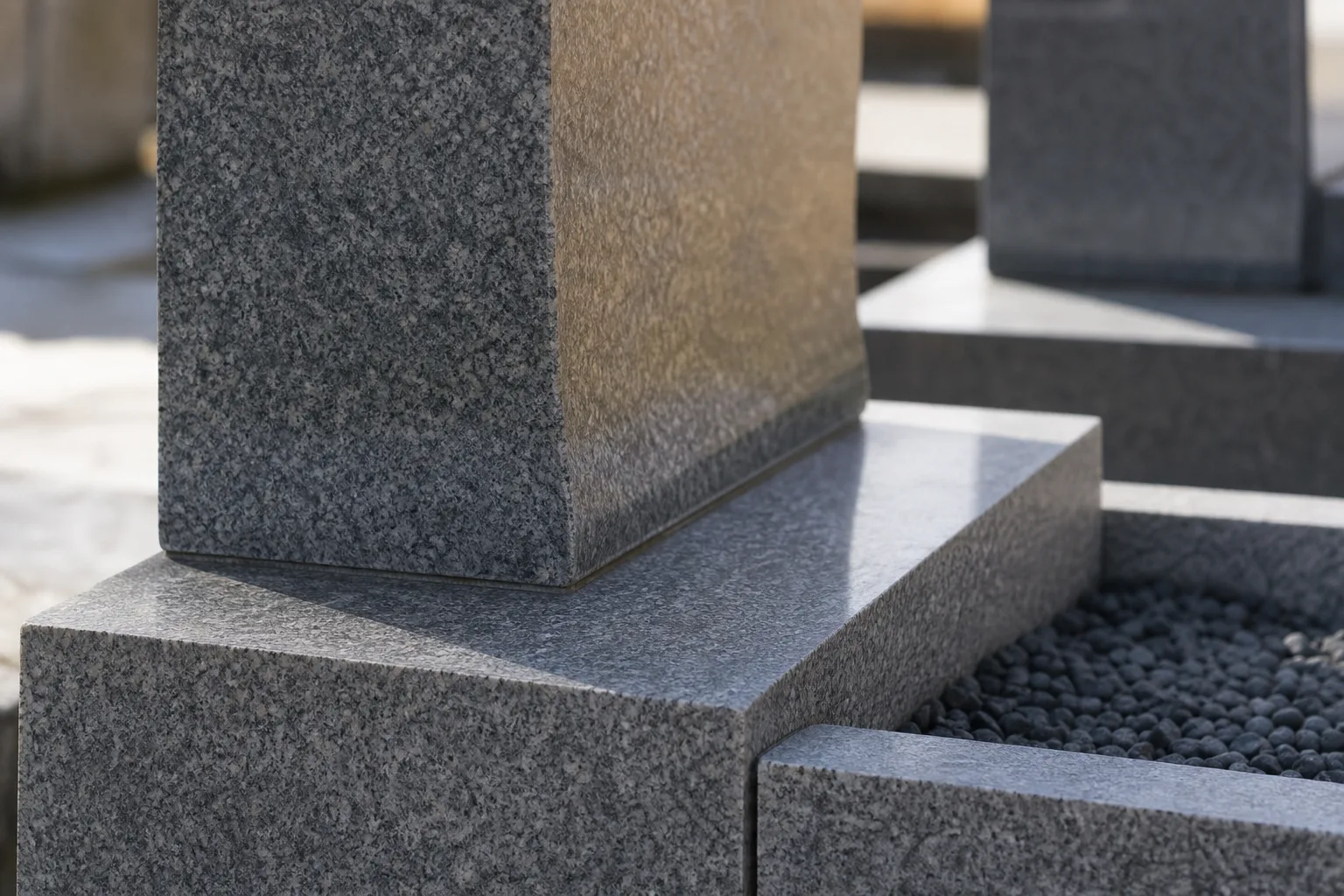
The document that decides what your family's stone may look like is called the Friedhofssatzung, and it is a piece of local law, adopted by the municipality or by the parish that owns the ground, published, amendable, and enforceable against you after the stone is already standing. It is not a style guide and it is not advisory. It sets material, maximum and minimum height, minimum thickness, footprint, foundation depth, and in a surprising number of towns the permitted lettering and the permitted symbols. A careful reader gets the current version in writing before commissioning anything, because the version in force is the one that governs the permit.
The bylaw first, the stonemason second
Most families do this backwards: they choose a design they like, take it to a stonemason, and discover the constraints at the end. Reverse the order. Ask the cemetery office (the Friedhofsverwaltung, or in a church-owned cemetery the Kirchengemeinde) for the Satzung and for the specific Abteilung, the section, in which the grave sits. The office holds a plot register that names the section, the row, the number, the grave type, and the lease term, and the applicable design rules follow from the grave type rather than from anything you decide. Once you have both documents, a stonemason can quote against something real.
Upright stone or flat plate, and why the section decides
German cemeteries are zoned. A Wahlgrab, the chosen family plot with a renewable lease, usually permits an upright monument, a Stele, sometimes with a base slab and planting bed. A Reihengrab, assigned in sequence for a fixed term, is frequently restricted to a smaller upright or to a flat plate laid flush with the turf. Urn sections, lawn sections mown by machine, and the newer communal fields often permit nothing but a flush plate of a stated size, because a projecting edge stops the mower. The comparison that matters is not upright versus flat in the abstract. It is what this section, on this row, allows this year.
Height limits typically run in tiers, with the tallest permitted stones at the head of a section and lower ones toward the paths, and thickness minimums exist for a structural reason: a thin slab set upright in frost-heaving ground eventually leans, and the cemetery, not the family, carries the liability for a stone that falls. That is also why annual stability testing, the Standsicherheitsprüfung, exists, and why the foundation specification in the Satzung is worth reading as carefully as the height table.
Polished granite, historic churchyards, and material rules
Older churchyards, and any cemetery carrying a Denkmalschutz designation or sitting inside a protected ensemble, commonly restrict high-gloss finishes. The language varies, but the effect is consistent: mirror-polished black granite, laser-etched photographic portraits, gilded machine lettering, and imported speckled stone in colors foreign to the region are excluded in favor of local sandstone, limestone, Muschelkalk, or granite worked to a honed, bush-hammered, or split face. Some parishes go further and require hand-cut lettering. None of this is aesthetic snobbery alone. It keeps a burial ground that has looked one way for two centuries legible as a single thing.
Then there is provenance. Several German states, along with a long list of individual municipalities, require documentation that a stone was not produced using illegal child labor, satisfied by a recognized certification covering the quarry and the finishing workshop. This bites hardest on granite from India and China, which is much of the cheap material on the market. In the United States, the Department of Labor is responsible for tracking child labor in international supply chains, so the underlying concern will be familiar; the German version simply attaches it to a building permit. Ask your stonemason for the certificate number before you sign.
What a careful reader actually checks
Five things, in order. Which section and grave type the plot belongs to, and whether the lease has enough term left to justify the spend. The height, width, thickness and foundation figures for that section, in millimeters, from the current Satzung. Whether the finish is restricted and whether lettering must be cut rather than sandblasted. Whether provenance certification is required in that state or town. And finally, whether the stonemason's quote includes the permit application, the foundation, the setting, and the removal of the temporary marker, because those line items move a price considerably and are easy to leave out.
Approval is usually a short administrative step once the drawing matches the rules: a scaled sketch, the material and finish named, the dimensions stated, submitted by the mason and stamped by the office. Families who read the bylaw first almost never hear no.